Where Horror Gets Studied, Skewered, and Celebrated.
Newest articles and reviews
(Sundance Film Festival) BUDDY Is a Unicorn-Fueled Descent Into Mascot Horror
By. Professor Horror
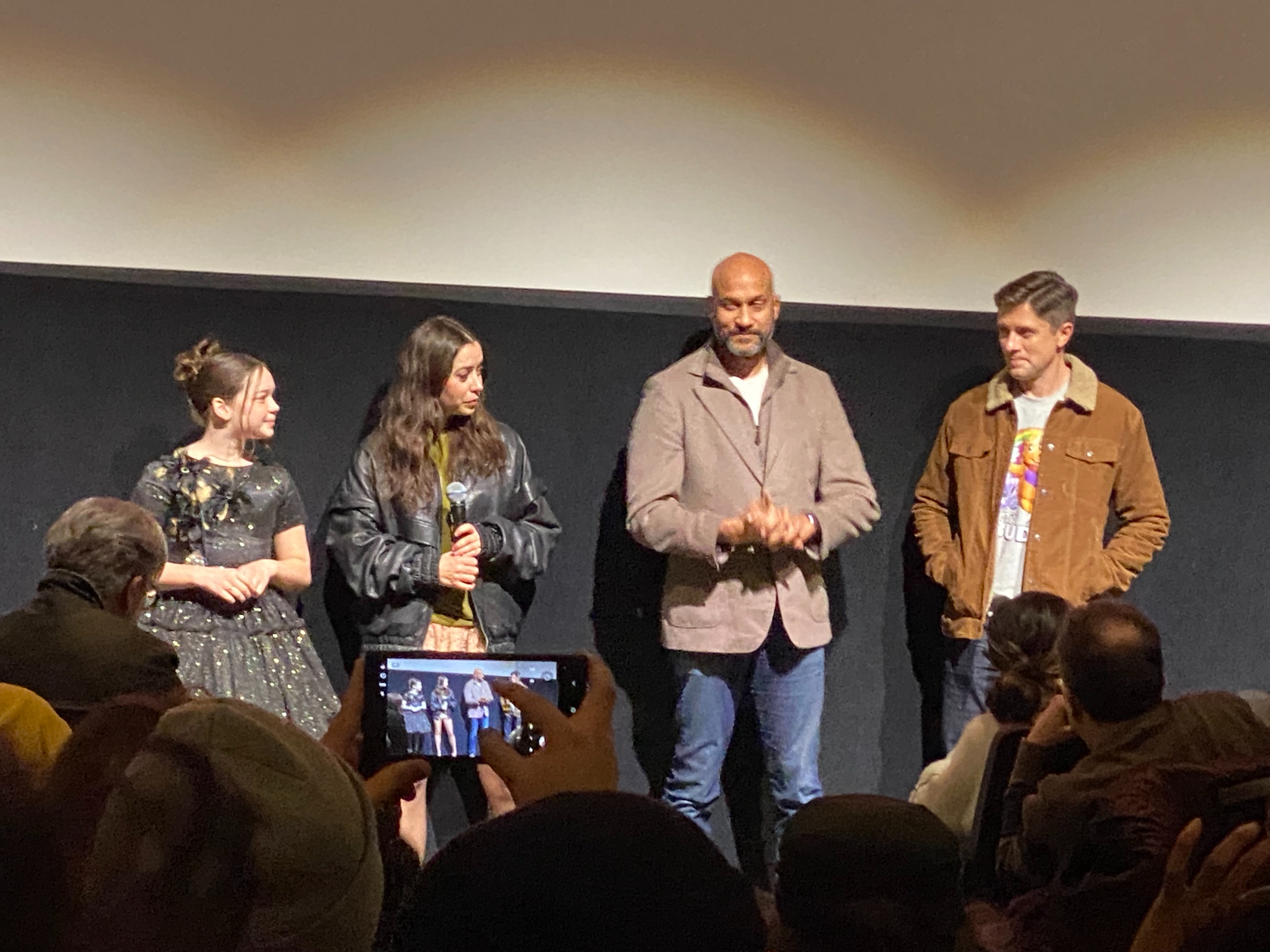
The first time I saw the Adult Swim 11-minute short “Too Many Cooks,” it was late at night, I was half-asleep (or drunk), and by morning I genuinely wondered if I’d dreamt the whole thing. It felt like something I wasn’t supposed to have seen, and I definitely hesitated to describe it to anyone out of the fear they would assume I was unwell. I had that exact same feeling again sitting down to describe BUDDY. The film had its world premiere at the Sundance Film Festival and immediately announced itself as another beautifully deranged entry from Casper Kelly’s brain. Like “Too Many Cooks”, Kelly’s new film starts in a cutesy, aggressively wholesome television space and then patiently dismantles it piece by piece, all while daring the audience to keep smiling along. Marketed as “mascot horror,” BUDDY stars Delaney Quinn, (If I had Legs I’d Kick You) Cristin Milioti (How I Met your Mother), Topher Grace (That 70’s Show), and features Keegan-Michael Key (Key & Peele) voicing its titular unicorn, but it’s Kelly’s tonal control that does the real damage. There’s a faint moral hum about the dangers of using screens and tv characters as emotional babysitters, yet the film never pretends it’s anything other than a gleefully unhinged ride through a brightly colored nightmare that knows exactly how ridiculous (and how upsetting) it wants to be.
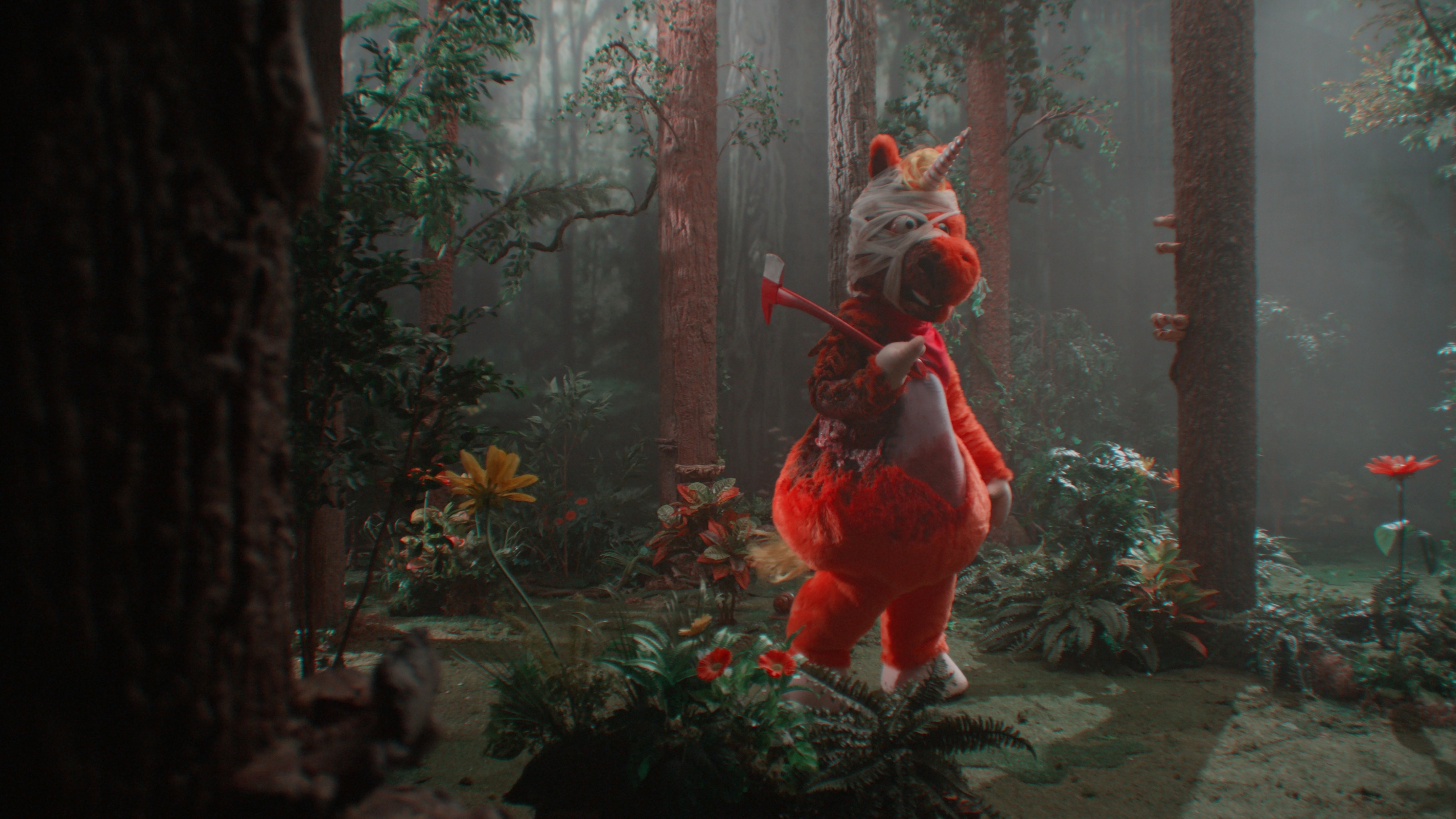
Buddy is a bright orange unicorn from a magical land who sings chipper songs about being brave, dancing, and cleaning. The resemblance to Barney the Dinosaur is impossible to miss, and Kelly leans into that cultural memory with a knowing grin. While preschoolers adored Barney, older kids and adults famously loathed him, reacting with a level of vitriol that bordered on the irrational. And yes, some kids were even afraid of the big purple dinosaur, and many others just deeply resented his relentless cheer. It feels like years of hating Barney finally came to a head, and now we get to watch that frustration play out as full-on puppet carnage. And once you’re in that headspace, the rest of the show’s world falls right into place: googly-eyed inanimate objects (a mailbox, a backpack, a train) voiced with absurd seriousness by actors like Patton Oswalt and Michael Shannon, creating a Pee-wee’s Playhouse-esque ecosystem where everything is friendly and nothing has boundaries. Kelly’s meta charm especially thrives here because the puppets are immaculate, the textures are tangible, and the artifice is so lovingly constructed that you almost forget how unsettling it is to be emotionally blackmailed by a unicorn.
However, the pastel fantasy collapses the moment a child refuses to obey Buddy, which triggers a tonal shift reminiscent of The Twilight Zone’s “It’s a Good Life,” where survival depends entirely on keeping a volatile child happy. Buddy doesn’t just want affection…he needs it, he feeds on it, and he punishes its absence with horrifying efficiency. Freddy (Quinn), initially skeptical and quietly observant, becomes the first to suspect that one of the children hasn’t gone where Buddy claims, and the young actress plays this dawning realization with impressive skills. As her suspicions spread, the film leans harder into its central joke: that the language of kindness becomes far more disturbing when it’s enforced at knifepoint. As the violence ramps up, so does the film’s humor, with laughs coming from the grotesque contrast between glittery sing-alongs and Buddy’s increasingly violent language. The violence lands because it clashes with everything Buddy is supposed to represent. He’s built to teach empathy, and instead he uses it to control people. Love becomes a requirement, not a choice, and the cheerful colors only make the cruelty feel worse.
Roughly thirty minutes in, BUDDY pulls the rug out from under the audience by shifting perspective into the “real world,” landing in a pristine suburban home where Grace (Milioti) begins to sense that something is deeply and cosmically wrong. While some viewers found this transition jarring, the collision between reality and television logic is precisely what makes the film so unsettling. The threat no longer belongs to a contained fantasy space, but it bleeds outward into the real world as it affects adulthood, memory, and even domestic routine. Milioti kills it here, playing Grace as a woman haunted by a dread she can’t quite articulate and no one else seems to notice, which grounds the film’s strangest turns in some genuinely believable emotional outbursts. Like “Too Many Cooks”, Kelly delights in destabilizing the audience’s sense of place and reminds us that no world (fictional or otherwise) remains safely sealed. When tv logic invades reality, Buddy becomes more than a killer mascot because he becomes an idea that refuses to turn off.
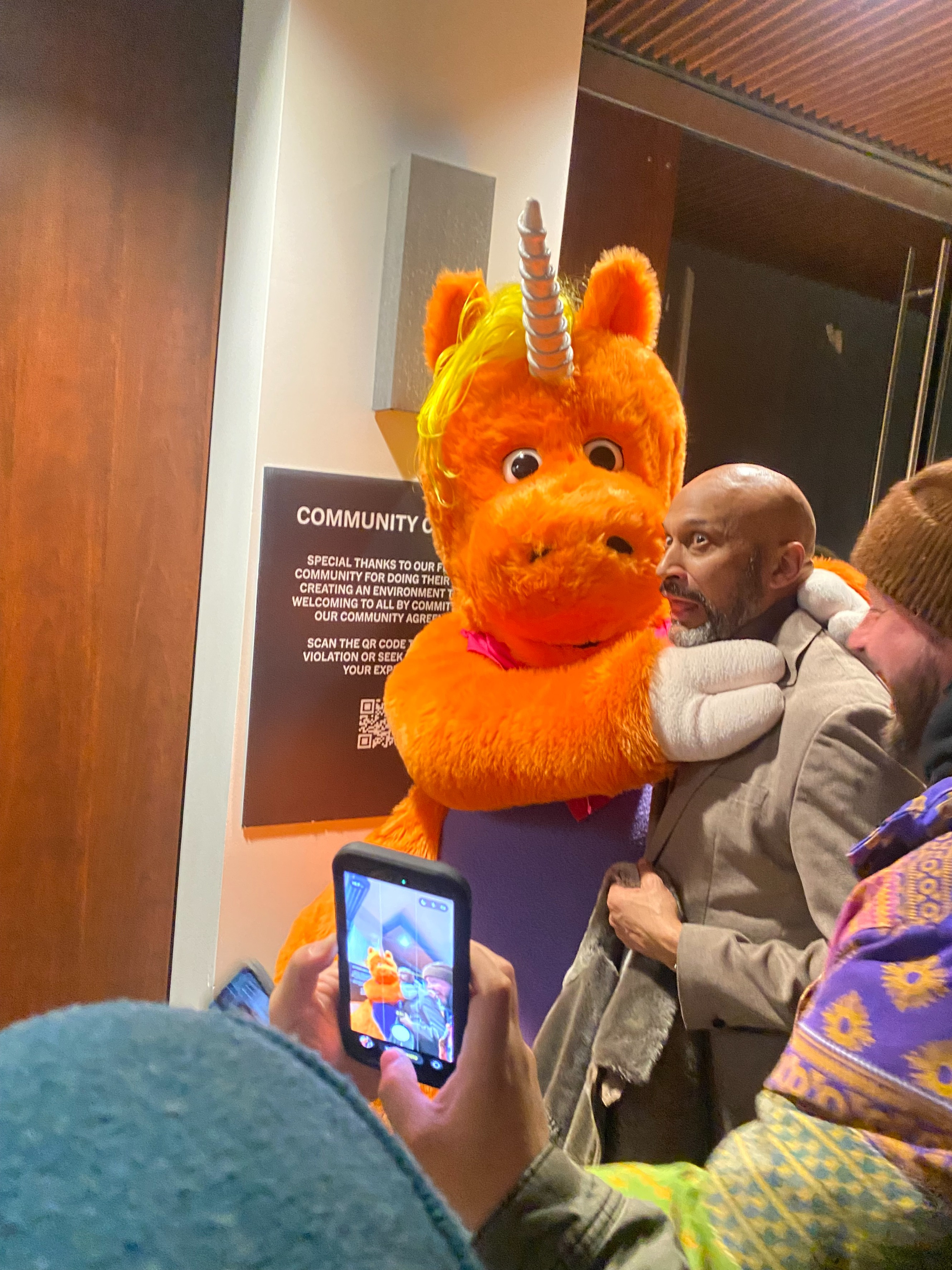
There is truly nothing else quite like BUDDY. It isn’t a remake, a parody, or a nostalgic cash-in, but a singular artifact born from the strange, looping anxieties in Casper Kelly’s head. The film’s charm lies not in originality for its own sake, but in how meticulously it commits to its bizarre premise and how it trusts worldbuilding and tone to do the heavy lifting. The puppetry deserves special applause (expressive, tactile, and unsettling in ways CGI could never replicate) and BUDDY makes a compelling case that we desperately need more R-rated puppet horror. Kelly understands that puppets bypass logic and go straight for the subconscious, as they tap into childhood memories whether we like it or not. In the end, BUDDY isn’t just about the evil lurking beneath kids’ shows…it’s about how much of that evil we were already projecting onto them.
BUDDY is currently seeking distribution, but I suspect soon enough we can all sing and dance along with Buddy.
About Professor Horror
At Professor Horror, we don't just watch horror: we live it, study it, and celebrate it. Run by writers, critics, and scholars who've made horror both a passion and a career, our mission is to explore the genre in all its bloody brillance. From big-budget slashers to underground gems, foreign nightmares to literary terrors, we dig into what makes horror tick (and why it sticks with us). We believe horror is more than just entertainment; it's a mirror, a confession, and a survival story. And we care deeply about the people who make it, love it, and keep it alive.